
Overcoming Observation Bias: A Framework for Continuous Passive Safety Auditing via Computer Vision
Construction Safety | AI Workflow | Building Safety Officer | HSE | Hawthorne Effect | Computer Vision | AI Productivity Guide | AI for Construction
Description
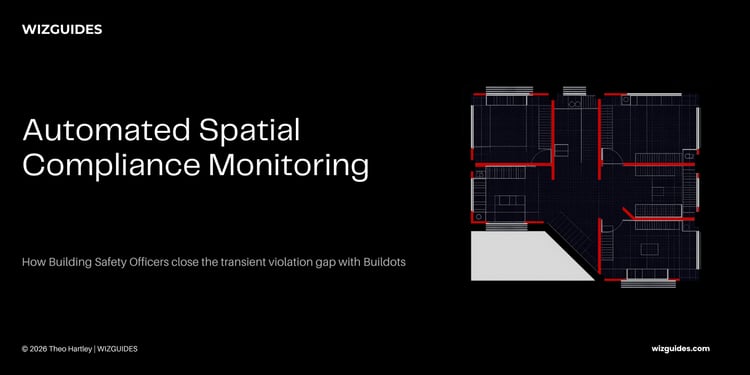
This guide shows senior Building Safety Officers how to deploy 360° cameras and Buildots computer vision to establish a continuous, timestamped, forensic evidentiary record of site safety conditions. It addresses the core professional problem: traditional safety walks capture a momentary performance, not the real site state, because workers modify their behaviour when they know they are being observed. The Hawthorne Effect can reduce PPE compliance by 30–60% in observed conditions, leaving officers unable to answer the post-incident question with evidence: "What was the condition of the site at [specific time]?"
This guide is written for senior Building Safety Officers working in high-risk construction environments — high-rise residential, infrastructure, and large-scale commercial — who need systems that are more evidence-based, more systematic, and more defensible. It is not a sales pitch. It is a professional framework.
You can't be everywhere at once. Workers know it. That's not a character flaw — it's the Hawthorne Effect, and it's been studied since the 1930s. PPE compliance drops 30–60% when people believe they're unobserved. Your morning walk shows compliance. The rest of the day doesn't.
The question isn't whether this is happening on your site. The question is what you're going to do about it.
The Post-Incident Question
After a serious incident or HSE inspection, the question asked is: "What was the condition of the site at [date] at [time]?" Not, "Did you try?" It's always, "What was the state?"
Traditional safety audits cannot answer that question for 23 hours of the day. Buildots can. Every deviation is timestamped, geolocated, and photographed. This is not a memory — it is a forensic record of what actually happened.
The System: 360° Cameras + Buildots + Officer Authorisation
This guide shows you how to convert routine site walks into a continuous, evidence-based safety monitoring system.
The four-step workflow:
- Passive Data Acquisition — Superintendents wear 360° cameras during routine morning and afternoon walks. No announced audit. Workers are told the camera watches the site, not individuals. The Hawthorne Effect is significantly reduced because there is no event to react to.
- Computer Vision Detection — Buildots processes the footage against a configurable safety matrix. Every hardhat absence, harness gap, blocked fire exit, and untagged scaffold element is flagged — with photographic evidence, location, time, and severity.
- Officer Review and Authorisation — You review every flag. You investigate root cause. You authorise every corrective action. Buildots identifies deviations. You make the decisions.
- Systemic Risk Intervention — You analyse patterns across time and location, not individual violations. You address the conditions producing hazards — not the individuals exposed to them.
Why This Approach Works
Standard audits capture a performance. Passive observation during routine walks captures the actual site state.
The ethical framing is accurate and it matters: "This camera watches the site — it checks that edge protection is in place, that materials are stored correctly, and that fire exits are clear. It does not identify individuals."
When Buildots data shows that harness non-compliance spikes at 14:30 every Wednesday on Tower A — because floor supervisors are in the management meeting — you have evidence for a management conversation, not a worker punishment. You address the supervision gap. The compliance problem resolves.
GDPR: Built In, Not Bolted On
The "no facial recognition" guarantee is the ethical foundation of this entire system — and it is also the feature that makes it legally defensible.
Buildots uses object-detection algorithms trained on visual characteristics of PPE items. It does not extract facial features, generate biometric templates, track individuals across frames, or profile worker behaviour.
Lawful basis: Article 6(1)(f) — Legitimate Interests (health and safety). A Legitimate Interests Assessment and a completed DPIA are prerequisites, not afterthoughts. The guide walks you through both.
ICO-compliant. GDPR/UK GDPR compliant. Workforce-trust-ready.
Real Results: The Birmingham Case Study
David R. deployed this system on a 32-storey twin-tower residential project in Birmingham. His problems under the manual regime: one tower always unobserved, workers removing harnesses out of sight, three hours per day consumed by manual walks.
Three months post-implementation:
| Metric | Before | After |
|--------|--------|-------|
| Harness compliance (Tower A, 14:00–15:00 Wed) | 61% | 94% |
| Friday afternoon compliance | 68% | 88% |
| Daily officer time (monitoring) | 3 hours | 45 minutes |
| HSE file completeness | Spot observations | Full timestamped log |
David now spends his time on what officers are actually for: analysing root causes and making evidence-based management decisions.
What's Included
Guide-Workbook — Overcoming Observation Bias
- Why the Hawthorne Effect defeats manual auditing — and why it's not the workers' fault
- The four-step continuous passive auditing workflow
- GDPR compliance: LIA, DPIA, induction policy, union consultation, disclosure statement
- Safety matrix configuration — core categories and review schedule
- Systemic risk analysis: from reactive policing to root cause intervention
- Five exercises: site mapping, matrix configuration, pattern analysis, induction drafting, formal safety instruction
- The complete David R. worked example
- Pre-deployment action checklist
Prompt Pack — Copy-Paste Frameworks
- 3 safety matrix templates (high-rise, infrastructure, fit-out)
- 2 site induction scripts (union and non-union)
- 4 ChatGPT prompts (weekly trends, formal safety instructions, HSE reports, subcontractor reviews)
- Camera walk route planning template
- Full GDPR compliance checklist
- Mandatory disclosure statement for reports
Tool Stack
- Buildots — Computer Vision Engine (2026)
- 360° Hardhat Cameras — Insta360, Ricoh Theta, or equivalent
- ChatGPT — GPT-4o (March 2026) — optional
- Tested with Buildots platform, GDPR-compliant workflows, June 2026
Who It's For
Senior Building Safety Officers in high-risk construction: high-rise residential, infrastructure, large commercial. You already know your job. This guide shows you how to make it more systematic, more evidence-based, and more defensible.
If you've been sold black-box solutions before and been left doing the work anyway, this will feel different. Every workflow is described in enough detail to implement. Every limitation is stated honestly.
Your Professional Accountability Is Not Negotiable
AI accelerates observation and documentation. The Building Safety Officer authorises every safety decision. The forensic evidentiary record protects you — and the system that created it does not replace you.
Download the Guide-Workbook + Prompt Pack Bundle
Everything you need to implement the workflow on your next project.
Two-part bundle: Combined Guide-Workbook (comprehensive) + Prompt Pack (copy-paste templates)
Includes:
- Full guide-workbook with methodology, worked example, and five exercises
- Complete prompt pack with prompts for every stage of the workflow
- Camera walk route planning template
- Full GDPR compliance checklist
- Mandatory disclosure statement for reports
---
© 2026 Theo Hartley | WIZGUIDES
⚖️ Practical AI for Professionals ⚖️