


Automated Spatial Compliance Monitoring: Enforcing Egress Protocols and Material Storage Constraints with AI
Construction Safety | Building Safety Officer | CDM 2015 | Egress Routes | Fire Safety | Construction Compliance | Spatial Compliance | AI Workflows | AI For Professionals
Description
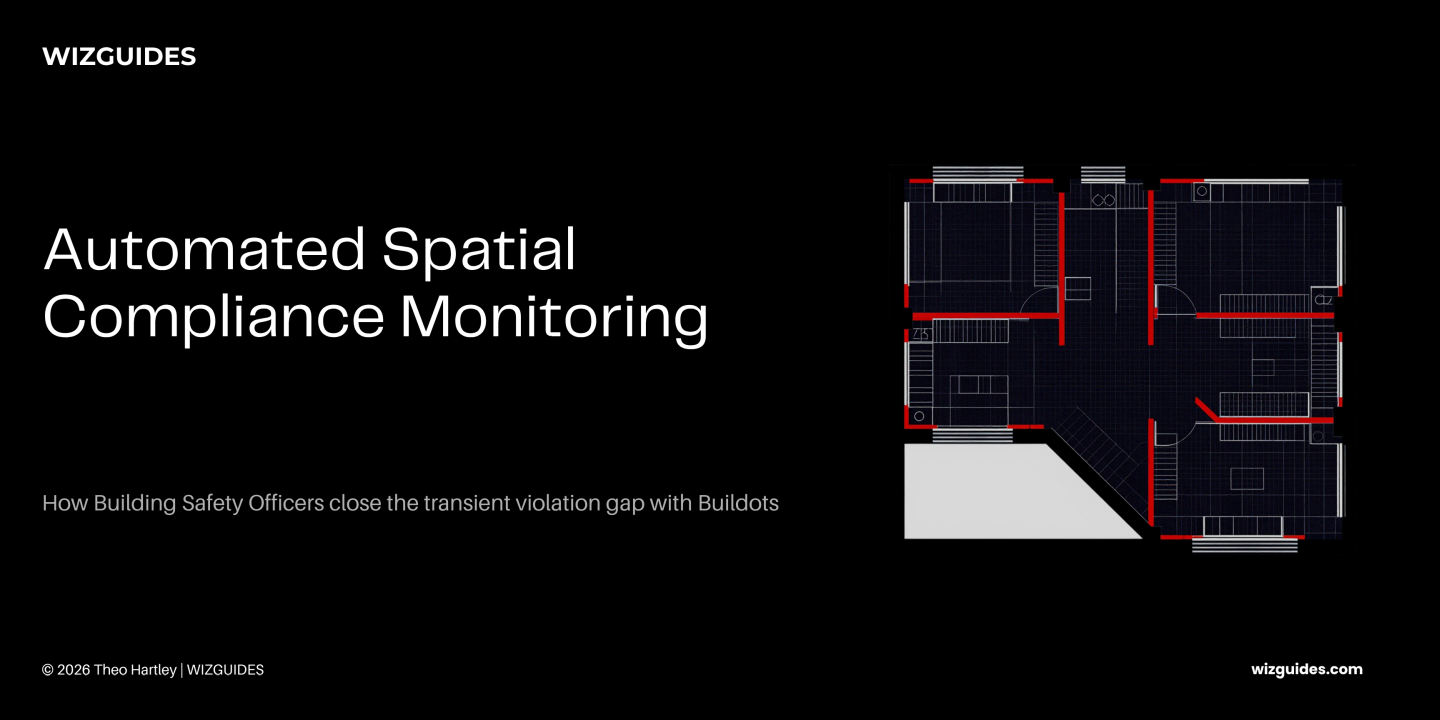
How Building Safety Officers Use Buildots Spatial Tracking to Detect Transient Violations, Generate Objective Compliance Evidence, and Renegotiate Site Logistics Protocols — Without Replacing Professional Judgement.
This guide equips Building Safety Officers and Site Inspectors with a systematic, evidence-based methodology for monitoring and enforcing spatial compliance on construction sites. It addresses the transient violation problem: egress routes and fire lanes that are blocked for 20 minutes — long enough to constitute a regulatory breach under CDM Regulations 2015 Regulation 18(2)(e) and Article 14 of the RRO 2005 — yet invisible to manual inspection schedules. The methodology uses Buildots Spatial Tracking Engine to continuously monitor digitally defined zones during routine 360-degree site walks, generating objective violation data that the Building Safety Officer reviews, verifies, and acts upon.
The guide is designed for Building Safety Officers and Site Inspectors working on medium-to-large construction sites who need a defensible, data-supported approach to zone compliance management.
The Transient Violation Problem
At 10:15, a delivery vehicle blocks the fire lane.
At 10:35, it moves.
Your manual inspection at 9:00am showed the fire lane clear. By the time you walk the site at 10:45, nothing remains of the obstruction. You've recorded full compliance.
You've also recorded a site that was in breach under CDM Regulations 2015 Regulation 18(2)(e) and the Regulatory Reform (Fire Safety) Order 2005 Article 14 for 20 minutes — entirely invisible to your inspection routine.
This is the transient violation problem. It's the hardest compliance gap to close, and the one most likely to cause regulatory failures during surprise inspections.
The Compliance Gap Nobody Talks About
Construction sites are dynamic. Egress routes and fire lanes change hourly. A staging area clear at 9am is full by 10am. A fire lane clear after lunch is blocked by 2pm. The gap isn't about carelessness — your site has protocols, your workers know the rules. The problem is that manual inspection captures a snapshot, not the full picture.
Then an HSE inspector arrives without prior notice.
The inspector notes a partially obstructed fire lane. You know it was an exception — but can you prove it? Your compliance record shows no violations logged. No data. Nothing to demonstrate the active management that preceded this moment.
The answer is systematic spatial monitoring: continuous tracking that captures what manual inspection cannot reach, and objective evidence that demonstrates genuine compliance culture.
The Solution: Buildots Spatial Tracking + AI Workflows
Buildots Spatial Tracking Engine continuously monitors the location of materials, vehicles, and structures within digitally defined no-go zones during routine 360° site walks.
Twice-daily Zone Type A walks at 07:00 and 13:00 bracket the peak delivery window. Buildots flags violations automatically. The Building Safety Officer verifies each one on site and determines the enforcement response.
The five-step workflow:
- Zone Classification — Zone Type A (Hard Restriction), Zone Type B (Operational), Zone Type C (Temporary). The regulatory basis is defined for each zone.
- Digital Zone Definition in Buildots — Precise zone boundaries are the compliance threshold. Vague definitions produce unreliable data.
- Continuous Spatial Analysis — Twice-daily 360° walks for Zone Type A. AI flags encroachment; the Officer verifies.
- Transient Violation Heat Maps — Weekly analysis identifies which zones are worst, when peak violations occur, whether the situation is improving.
- Proactive Compliance Enforcement — Data-supported logistics renegotiation with the principal contractor. Measure the improvement with Buildots.
AI Accelerates; the Officer Authorises.
Buildots flags violations from routine 360° site walks. The Building Safety Officer verifies each one on site and determines the enforcement response — using objective spatial data to renegotiate logistics protocols with the principal contractor.
The CDM 2015 Regulatory Context
- CDM Regulations 2015 Regulation 18(2)(e): emergency routes must be kept free from obstruction.
- RRO 2005 Article 14: emergency routes and exits must be maintained in efficient working order and kept free from obstructions.
- Fire and Rescue Service access requirements: minimum 3.5m width and 4.2m headroom clearance.
The zone classification system maps these statutory requirements to specific, monitored areas. Buildots captures encroachment events. The Officer verifies and determines the enforcement response. The compliance record demonstrates active zone management.
This guide does not attempt to redefine your professional obligations. It provides the framework to fulfil them more systematically.
The 5 AI Workflows at a Glance
- Workflow A — Digital Zoning Definition: Classify site areas into Zone Types A, B, and C. Define each zone precisely in Buildots. Vague boundaries produce unreliable data — this step matters.
- Workflow B — Continuous Spatial Analysis: Twice-daily Zone Type A walks. Daily Zone Type B walks. Upload to Buildots within 2 hours. AI flags violations as a screening tool; the Officer verifies physically on site.
- Workflow C — Transient Violation Detection and Heat Map Generation: Weekly heat maps from Buildots data. Heat Level 1 = full compliance. Heat Level 4 = 6–10 violations or 30+ minutes total obstruction. Level 5 requires immediate escalation.
- Workflow D — Proactive Compliance Enforcement: "14 fire lane blockages totalling 187 minutes, average 13.4 minutes, during the 09:30–11:30 delivery window." That's a logistics renegotiation brief. Not a complaint.
- Workflow E — Monthly Reporting and Regulatory Documentation: Monthly compliance report drafted from Buildots data. Filed in the site compliance record. Available in 60 seconds when the HSE inspector arrives.
The Worked Example: Bristol Commercial Development
Sarah K. is a Building Safety Officer on a 15-storey reinforced concrete commercial development in Bristol city centre.
Week 1 Buildots data: 14 fire lane blockages totalling 187 minutes. Average blockage: 13.4 minutes. Most violations occurred during the 09:30–11:30 delivery window. Manual inspection at 9:00am had recorded full compliance every day.
Sarah used the Claude 3 logistics renegotiation brief template. She presented the data to the logistics manager: 14 blockages, 187 minutes, 8 stairwell egress obstructions totalling 64 minutes. Three protocol changes were agreed.
By Week 3: fire lane violations dropped from 14 to 3. Egress route violations dropped from 8 to 1. **78% reduction in violations within three weeks.**
At Week 6, an HSE inspector visited without prior notice. The inspector noted a partially obstructed fire lane near the entrance. Sarah pulled the Buildots record immediately: 2 violations in the past 30 days, both under 5 minutes. Week 1 had 14. The inspector reviewed the trajectory, noted the improvement, and closed the inspection with no enforcement action.
What's Included
Guide + Workbook
- Complete zone classification methodology: Zone Type A (Hard Restriction), Zone Type B (Operational), Zone Type C (Temporary)
- Full regulatory framework: CDM 2015 Regulation 18(2)(e), RRO 2005 Article 14, Construction Phase Plan, HSE CIS10, Fire and Rescue Service access requirements
- 5 step-by-step AI workflows with officer verification requirements at each stage
- Sarah K. worked example: Bristol 15-storey RC frame, from 14 violations to 3 in three weeks, HSE inspection outcome
- 5 practical exercises for immediate application on your current project
- Tool documentation: Buildots, Microsoft Excel / Google Sheets, Claude 3 / ChatGPT
Prompt Pack (copy-paste templates)
- Prompt 1B: Zone Classification Checklist for Buildots
- Prompt 2B: Site Walk Verification Checklist
- Prompt 3A: Weekly Violation Heat Map Generation
- Prompt 3B: Logistics Protocol Renegotiation Brief
- Prompt 4A: Monthly Spatial Compliance Report
- Prompt 4B: Regulatory Inspection Response
Who Is This For
Building Safety Officers and Site Inspectors on medium-to-large construction sites. You hold CDM 2015 compliance responsibilities. You know the transient violation problem. You need objective evidence to support compliance conversations with logistics managers and principal contractors. You want tools that make you faster and more consistent — not tools that cut corners or replace your professional judgement.
Compatible with CDM Regulations 2015, RRO 2005, June 2026.
Tools Used
| Tool | Role |
|------|------|
| Buildots (Spatial Tracking Engine) | Continuous 360° walk analysis, no-go zone configuration, violation flagging |
| Microsoft Excel / Google Sheets | Violation log, weekly summary, logistics negotiation tracker |
| Claude 3 / ChatGPT | Weekly compliance report drafting, logistics protocol renegotiation briefs |
Download the Guide-Workbook + Prompt Pack Bundle
Everything you need to implement the workflow on your next project.
Two-part bundle: Combined Guide-Workbook (comprehensive) + Prompt Pack (copy-paste templates)
Includes:
- Full guide-workbook with methodology, worked example, and five workflows
- Complete prompt pack with prompts for every stage of the workflow
- 5 step-by-step AI workflows with officer verification requirements at each stage
- Sarah K. worked example: Bristol 15-storey RC frame, from 14 violations to 3 in three weeks, HSE inspection outcome
- 5 practical exercises for immediate application on your current project
---
© 2026 Theo Hartley | WIZGUIDES
⚖️ Practical AI for Professionals ⚖️