

Algorithmic Defect Resolution Tracking: Establishing Objective Standards for Subcontractor Liability Discharge
Construction Inspectors | Clerk Of Works | OpenSpace | Senior Snagging Inspectors | Defects Liability | JCT Contracts | AI for Construction | Building Inspectors
Description
How Building Inspectors and Clerks of Works Use OpenSpace.ai Field Notes and Compare to Build a Forensic, Timestamped Audit Trail, Verify Subcontractor Remediation Claims, and Discharge Liability Definitively.
This guide teaches Building Inspectors, Clerks of Works, and Senior Snagging Inspectors how to use OpenSpace.ai Field Notes and Compare to create an objective, timestamped, geolocated record of every defect on a construction project — enabling definitive subcontractor liability discharge and eliminating the most common end-of-project final account disputes. The liability discharge problem is well-documented: at practical completion, JCT contracts require the employer to verify that defects have been remedied to the standard of finish, but they provide no objective verification mechanism. Inspectors are left relying on inconsistent photographs and handwritten notes.
This guide provides the methodology and workflow framework to resolve that problem permanently. It is written for construction professionals who manage the end-of-project nightmare on medium-to-large projects: the hundreds of punch-list items, the subcontractors who claim fixes that may or may not be real, and the final account negotiation where both sides point fingers over whether a fix meets the standard.
The End-of-Project Nightmare
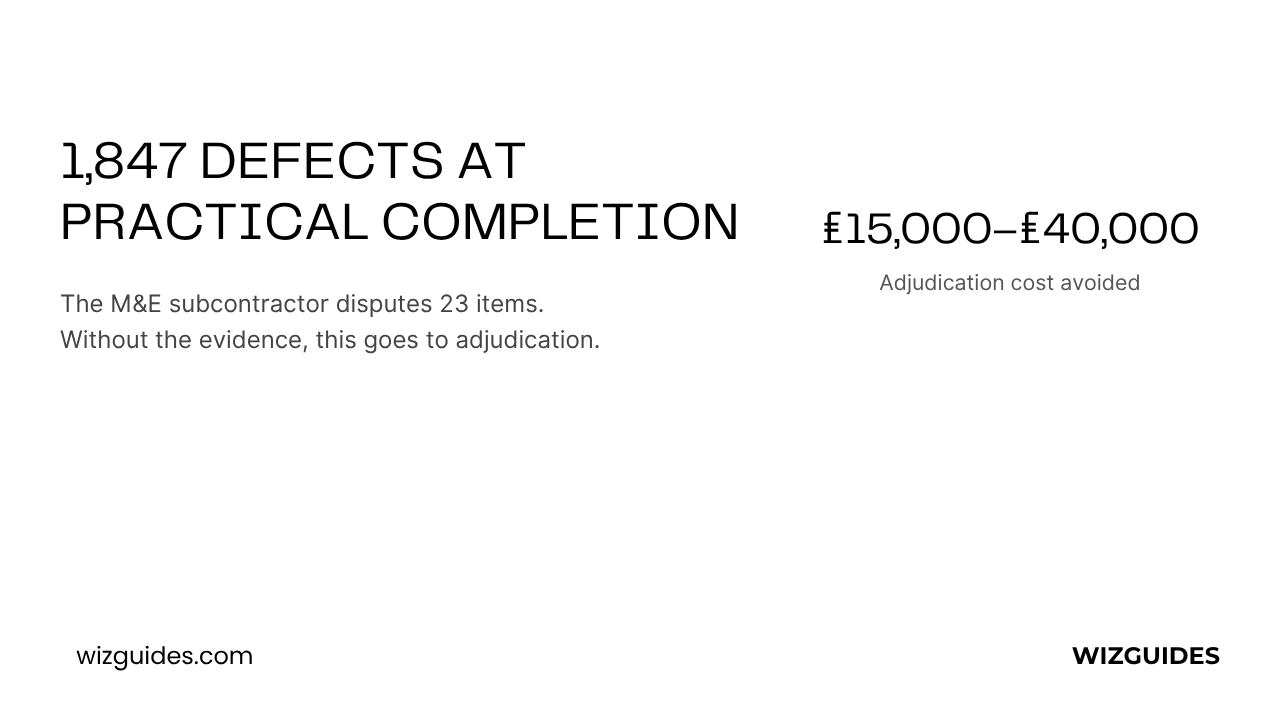
You have 1,847 open defects at practical completion.
The M&E subcontractor — £3.4M package, £170,000 in retention — says everything is resolved. Twenty-three items are disputed. Without photographic evidence, timestamped comparisons, and a named standard of finish, this is your word against theirs in final account negotiations.
Without OpenSpace, you spend weeks reconstructing a forensic record from six weeks of hurried site visits. With OpenSpace Field Notes and Compare, it's a three-hour conversation and a handshake.
Why Evidence Matters More Than Inspection
The punch-list verification problem is not a quality issue. It's an evidence issue.
By the time you reach practical completion, every stakeholder has an incentive to minimise their exposure. The contractor has completion certificates. The subcontractor has invoices from third-party repairers. The employer has a defects schedule — but not necessarily the evidence to back it up.
When the final account negotiation arrives, the gaps in the evidence record cost money. An adjudicator reviewing JCT 2016 Clause 2.20 — whether the employer was justified in withholding the Certificate of Making Good Defects — will ask: what evidence shows the defects were outstanding at the end of the defects liability period?
Without OpenSpace, that evidence is inconsistent photographs and handwritten notes from memory. With OpenSpace, it is a complete, timestamped, auditable export that both parties can trust.
The Four-Step Verification Workflow
- Step 1 — Capture: Navigate to the defect location in the OpenSpace 3D model. Pin the Field Note. Attach a 360° photograph. Record the applicable standard of finish — BS 8000 clause or NHBC chapter. The record is timestamped and geolocated automatically. No reconstruction required.
- Step 2 — Assign: Assign the Field Note to the responsible subcontractor via OpenSpace. Set a resolution deadline by category (A: 24 hours / B: 5 days / C: end of DLP). The timestamped assignment proves the subcontractor was formally notified within the contractual window. This is your evidence that the liability clock started.
- Step 3 — Compare: When the subcontractor claims resolution, run OpenSpace Compare. The platform aligns the current walkthrough camera position with the original Field Note coordinate and presents a side-by-side before-and-after comparison automatically. This is not a general photograph. It is a forensically aligned comparison of the same location at two points in time.
- Step 4 — Discharge: The Inspector reviews the Compare output and applies professional judgement against the specified standard of finish. Where the fix is verified, the Field Note is closed and a Liability Discharge Certificate is issued. Where it isn't, the defect remains open.
OpenSpace Compare provides the visual evidence. The Inspector makes the professional judgement. Full accountability stays with the qualified professional.
The Standard of Finish: BS 8000 as Your Reference
The difference between a professional Inspector and a punch-list compiler is the named standard.
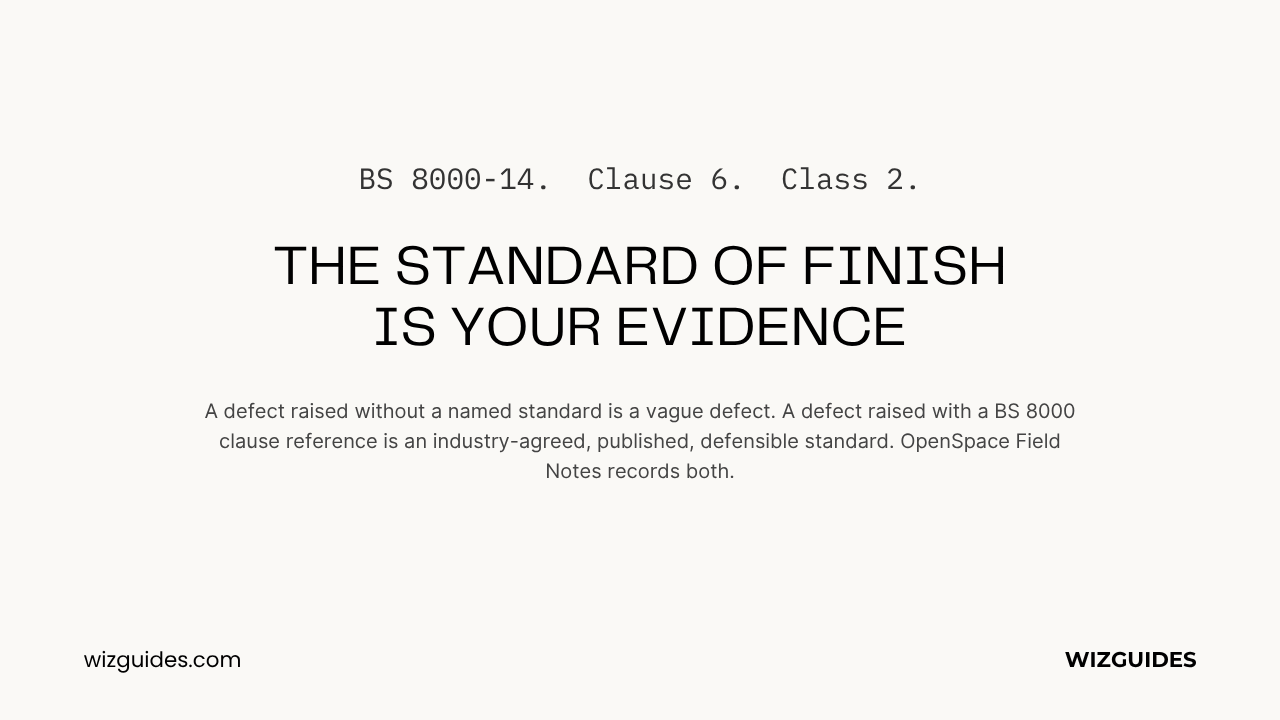
A defect raised as "paint finish issue" is a vague defect. A defect raised as "paint finish blemish, south wall Unit 4.2 bedroom, approx. 150mm x 80mm area of inconsistent sheen. Standard: BS 8000-14 Section 6, Class 2 finish. No runs, sags, or applicator marks visible at 1.5m under natural daylight" is an evidence-ready defect.
The BS 8000 series is cited in JCT contract disputes, adjudication decisions, and court proceedings. When an Inspector raises a defect with a reference to a specific BS 8000 clause, the standard is not their personal opinion — it is an industry-agreed, published reference that both parties are expected to know.
Key references:
- BS 8000-14 (painting): Class 2 finish — runs, sags, missed areas, and inconsistent sheen visible from 2m under natural daylight are defects
- BS 8000-8 / BS 5385 (tiling): Maximum 1mm lippage (tiles ≤300mm), maximum 2mm grout joint width deviation, no grout voids
- BS 8000-10 (carpentry): Gaps at visible junctions not to exceed 1mm
- NHBC Chapter 10.1: Screed — maximum 5mm deviation under 2m straightedge (bonded), 10mm (unbonded/floating)
Priority Scoring Formula
Priority Score = Severity (1–4) + Programme Impact (0–3) + Dispute Risk (0–3)
| Priority Score | Band | Action |
|---|---|---|
| 7–10 | Priority 1 | Inspect personally within 48 hours of resolution claim |
| 4–6 | Priority 2 | Inspect within 5 working days |
| 1–3 | Priority 3 | Inspect during scheduled final defects walk |
Example — Unit 7, Master Bedroom, North Wall:
Severity: 3 (large crack in drywall at corner, visible from doorway)
Programme Impact: 2 (client has booked photographer for marketing photos in 3 weeks)
Dispute Risk: 2 (drywall subcontractor disputes liability)
Priority Score: 7 → Priority 1
The Bristol Worked Example
James T., Senior Building Inspector. 120-unit residential development in Bristol. JCT SBC 2016. Fourteen trade subcontractors.
- At practical completion: 1,847 defects. M&E subcontractor (contract value £3.4M) disputes all 23 outstanding mechanical defects and demands release of £170,000 retention.
- Without the OpenSpace record: escalation to adjudication likely. Cost: £15,000–£40,000. Result: uncertain.
- With OpenSpace: James ran Compare on all 23 items in three hours. Nineteen showed clear remediation to standard. Four showed genuine outstanding defects, acknowledged by the M&E subcontractor at a 90-minute meeting. No adjudication. No legal correspondence.
Financial impact: Adjudication avoided: £15,000–£40,000. Legal costs avoided: £8,000–£25,000. £8,400 in retention legitimately retained on the 4 confirmed items. Retention sum released without dispute.
James spent three hours. The OpenSpace record did the rest.
The Ghost Defect Worked Example
Tiling subcontractor on a 60-unit apartment project refuses to address 7 tile defects at end of defects liability period. Their position: items were never formally raised and fall outside their scope. Inspector produces OpenSpace Field Notes. Each shows: timestamp confirming item raised within 48 hours of practical completion, geolocated pin, assignment to tiling subcontractor (confirmed by site agent), and resolution deadline that passed without remediation.
Subcontractor's director reviews the evidence. All 7 disputed items withdrawn. Repairs completed within 3 weeks.
Financial impact: £1,750–£4,200 in repair costs agreed. £3,000–£8,000 adjudication avoided.
What You Get
Algorithmic Defect Resolution Tracking — Guide-Workbook
The full methodology guide covering:
- JCT SBC 2016 and IC11 defects liability framework
- RIBA Plan of Work 2020 Stages 6 and 7
- Building Safety Act 2022 Golden Thread obligations
- Defective Premises Act 1972 and the statutory record
- Four-step verification workflow — Capture, Assign, Compare, Discharge
- BS 8000 and NHBC standard of finish references — clause-level detail
- Defect classification and Priority Score formula
- GDPR and worker privacy for 360° site capture
- Two full worked examples and five practical exercises
Defect Resolution Tracking — Prompt Pack
Copy-paste configuration frameworks:
- Project setup checklist (pre-defect-capture configuration)
- Field Note template (all required fields)
- Priority scoring matrix with worked examples
- ChatGPT prompt for defect closure summary reports
- OpenSpace Compare camera position protocol
- Subcontractor Liability Discharge Certificate template
- Evidence pack preparation checklist for final account disputes
Who It's For
Building Inspectors, Clerks of Works, and Senior Snagging Inspectors on medium-to-large construction projects who need to manage punch-lists at practical completion, resolve final account disputes without adjudication, apply BS 8000 standards in every Field Note from day one, and discharge subcontractor liability definitively.
Assumes professional knowledge of JCT contracts, defects liability provisions, and site inspection practice. You are the expert in your field. We handle the audit trail.
Tools Covered
- OpenSpace.ai — Field Notes + Compare (required)
- 360° Camera — Insta360 One X4 or Ricoh Theta Z1 (required)
- Procore / BIM 360 / PlanGrid — optional, defect record export
- OpenSpace Compare — forensically aligned before/after comparison
Tested with OpenSpace.ai platform. JCT SBC 2016 / IC11 compliant. Building Safety Act 2022 compliant. June 2026.
Download the Guide-Workbook + Prompt Pack Bundle
Everything you need to implement the workflow on your next project.
Two-part bundle: Combined Guide-Workbook (comprehensive) + Prompt Pack (copy-paste templates)
Includes:
- Full guide-workbook with methodology, worked example, and five exercises
- Complete prompt pack with prompts for every stage of the workflow
- GDPR and worker privacy for 360° site capture
- Two full worked examples and five practical exercises
- Subcontractor Liability Discharge Certificate template
- Evidence pack preparation checklist for final account disputes
---
© 2026 Theo Hartley | WIZGUIDES
⚖️ Practical AI for Professionals ⚖️