
The AI-Assisted Risk Register: Bullet-proofing Your Cost Estimates
Construction Finance | Quantity Surveying | Risk Management ! Commercial Management | AI For Professionals | AI in Construction
The AI-Assisted Risk Register is a decision-support tool. It produces a first-pass risk analysis — the Financial Manager applies professional judgement to decide which findings to act on. It does not audit cost plans. It does not replace QS expertise. It does not remove accountability from the FM/CM. The AI generates an evidence-based risk report from your uploaded data. You apply professional judgement. The documented trail is yours.
Description
This guide and workbook provides Financial Managers and Commercial Managers in construction and infrastructure with a structured, evidence-based methodology for assessing whether Quantity Surveyor-allocated contingency sums are sufficient—replacing gut feeling and rule-of-thumb with a defensible, documented process.
By deploying a ChatGPT CustomGPT trained on the organisation's own historical project data, a thorough contingency review can be completed in approximately 60 minutes, compared with 3–4 hours using traditional manual methods.
The workflow is designed for FM/CMs at UK main contractors and developers who receive finalised cost estimates from Quantity Surveyors and need to validate contingency before projects go to funder, client, or tender.
The Problem
Your QS has delivered a £4.5 million cost estimate. Contingency sits at 7.5%. Your gut says it's under-priced. But can you make that case — with evidence — in the next 48 hours?
The problem isn't that FM/CMs lack expertise. It's that they lack time and structure. Traditional contingency review means 3–4 hours of manual benchmarking, cross-referencing against vague memories of past projects, and drafting a review note that ends up being more impression than analysis.
Then the funder asks: "How was the contingency calculated? What specific risks were identified? What does your historical data show?"
And you're relying on notes that exist only in your memory.
In the context of a dispute — or a post-completion funder audit — "I thought it looked thin" is not a defensible position. The Carillion collapse and subsequent tightening of project finance standards have made contingency scrutiny a matter of professional accountability, not just commercial prudence.
Solution
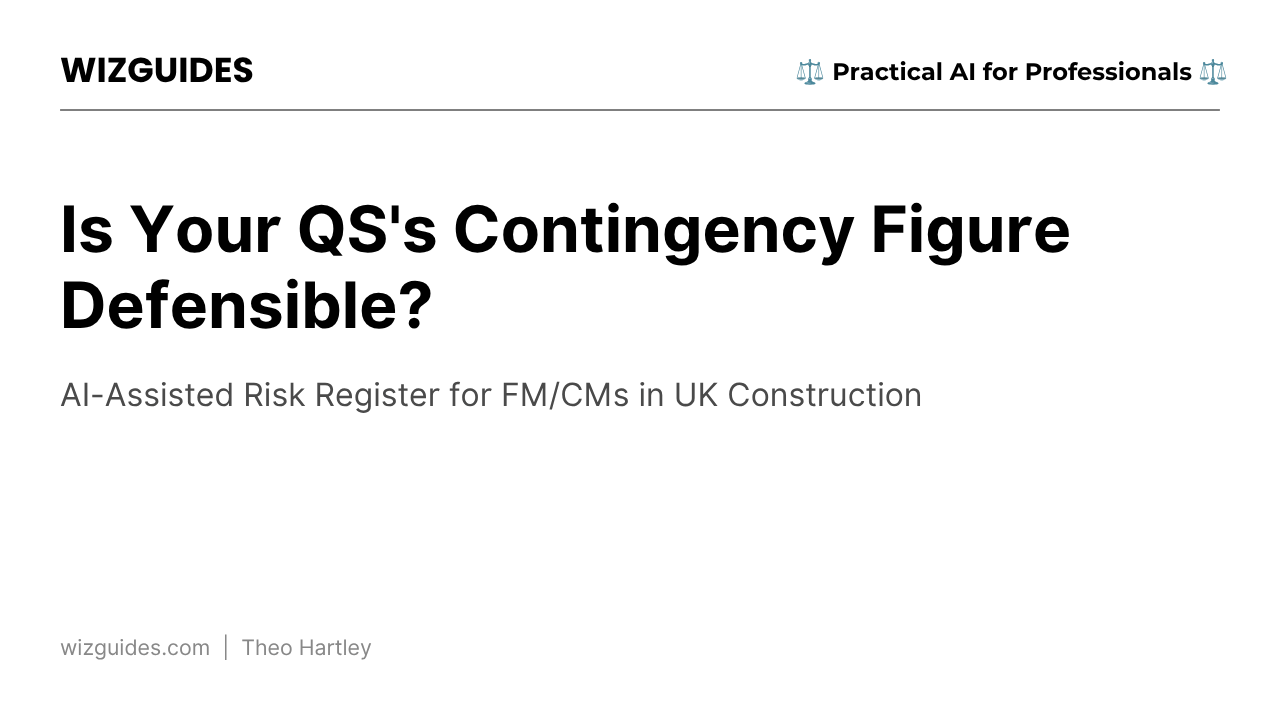
The AI-Assisted Risk Register is a structured, evidence-based methodology for challenging QS cost plans — using your organisation's own historical project data as the benchmark. A ChatGPT Custom GPT, trained on your past projects, cross-references the new cost plan and flags which trade packages appear under-contingencied — with specific historical benchmarks, variance figures, and citations.
You apply professional judgement. You challenge the QS. You document everything.
60 minutes. Not 4 hours. Evidence-based. Defensible.
Methodology Overview
- Step 1 — Train: Build and configure a ChatGPT Custom GPT on your historical project data (minimum 5 completed projects, trade-level variance breakdown).
- Step 2 — Upload: Export the cost plan to CSV. Upload the CSV and risk assessment PDF to the Custom GPT.
- Step 3 — Analyse: Run the cross-reference prompt. The AI produces a structured risk report flagging under-contingencied trade packages — with specific evidence from your own project history.
- Step 4 — Review: Apply professional judgement. Challenge the QS where appropriate. Complete the Excel matrix. Document everything in the project file.
What's Inside
Guide-Workbook
- Professional liability context: RICS NRM1, ISO 31000, PI insurance implications
- The four-step AI-First Pass workflow — complete, step-by-step
- Custom GPT configuration: system instructions, training data, validation protocol
- The cross-reference prompt — ready to paste into ChatGPT
- Full Manchester office fit-out worked example (4 hours → 60 minutes)
- The Excel Risk Contingency Review Matrix (three tabs: Main Matrix, Sensitivity Analysis, Sign-Off Log)
- Limitations, risk mitigation, and the 8-Point FM/CM Risk Checklist
- Five guided exercises — from data gathering to matrix sign-off
Prompt Pack (PDF template, copy-paste ready)
- 15 prompts across 5 tabs: Setup, Core Review, Excel, Communication, Quick Reference
- System instructions for the Custom GPT
- All review prompts, follow-up prompts, and escalation templates
- GDPR compliance prompt for ChatGPT data controls
Who It's For
Financial Managers and Commercial Managers at UK main contractors and developers who:
- Receive cost estimates from QSs and must validate contingency with evidence
- Face funder, client, or bank scrutiny before projects go to tender
- Need a documented, defensible process — not gut feeling
- Want to integrate AI as a first-pass tool while retaining full professional accountability
Not for QSs producing estimates. For the FM/CMs who receive and validate them.
Tools
- ChatGPT Custom GPT (GPT-4o, Plus or Team) — primary analysis tool
- Microsoft Excel (365, Windows) — Risk Contingency Review Matrix
- PDF reader — for reviewing risk assessment documents
Tested with ChatGPT Custom GPT and Microsoft Excel, June 2026.
GDPR Note — Your Cost Data Is Safe
Before using this workflow, you must configure ChatGPT's data controls:
- Disable conversation learning / training data in ChatGPT settings
- A Data Processing Agreement (DPA) with OpenAI is required for business use — available on ChatGPT Team and Enterprise plans
- Consider anonymising cost plans before upload (client name, project address, and identifying details removed)
The Guide includes a step-by-step GDPR compliance section covering DPA requirements, data minimisation, anonymisation workflows, and ICO guidance.
This workflow is not suitable where client confidentiality agreements prohibit third-party data transmission. Consult your DPO before first use.
Worked Example: Manchester Office Fit-Out
The scenario: Commercial office fit-out, Manchester city centre. Base estimate £4,500,000. QS contingency: £340,000 (7.5%). 20 trade packages.
The method: ChatGPT Custom GPT trained on 5 comparable past projects. Cost plan exported to CSV. Risk assessment PDF uploaded. Cross-reference prompt run.
The findings:
| Trade Package | QS Contingency | AI Recommended | Gap |
|---|---|---|---|
| Excavation / Substructure | 8% (£4,000) | 30% (£15,000) | +£11,000 |
| MEP (all packages) | 6% (£37,200) | 15% (£93,000) | +£55,800 |
| Preliminaries | 6% (£22,800) | 10% (£38,000) | +£15,200 |
| **Total shortfall** | | | **+£82,000** |
The outcome: Revised contingency of £427,500 (9.5%) agreed with QS. Documented trail saved to project file.
Time taken: 60 minutes (vs. 3–4 hours for traditional manual review).
Your Download
The AI-Assisted Risk Register — Guide-Workbook + Prompt Pack Bundle
Two documents. Ready to deploy. Instant digital delivery.
- Guide-Workbook PDF
- Prompt Pack PDF (all prompts copy-paste ready)
- Immediate access on payment
---
© 2026 Theo Hartley | WIZGUIDES
⚖️ Practical AI for Professionals ⚖️