

Algorithmic Fire Risk Assessment: AI-Assisted Workflows for Fire Safety Engineers and Responsible Persons
Fire Risk Assessment | Fire Safety | RRO 2005 | AI For Engineers | Fire Door Inspection | AI Workflows | FRA | PAS79 | Responsible Person | AI For Professionals
Description
How Fire Safety Engineers Use AI Tools to Accelerate Survey, Documentation, Risk Rating, and FRA Reporting — Without Replacing Professional Judgement.
This guide equips Fire Safety Engineers and Responsible Persons with a structured, deployable methodology for incorporating AI tools into Fire Risk Assessment (FRA) practice under the Regulatory Reform (Fire Safety) Order 2005 (RRO 2005) as amended by the Fire Safety Act 2023.
Six AI-assisted workflows are presented, covering fire door inspection, document comparison, spatial analysis, risk matrix generation, FRA drafting, and action plan prioritisation. Each workflow is framed within the PAS 79-1:2020 five-step methodology and the "AI Accelerates; Engineer Authorises" principle: AI tools assist the competent person, but the Fire Safety Engineer retains full professional accountability for every finding, rating, and statement in the final FRA document.
The guide is written for fire safety professionals who conduct FRAs on medium-to-large non-domestic premises — care homes, hotels, offices, schools, and mixed-use residential and commercial buildings.
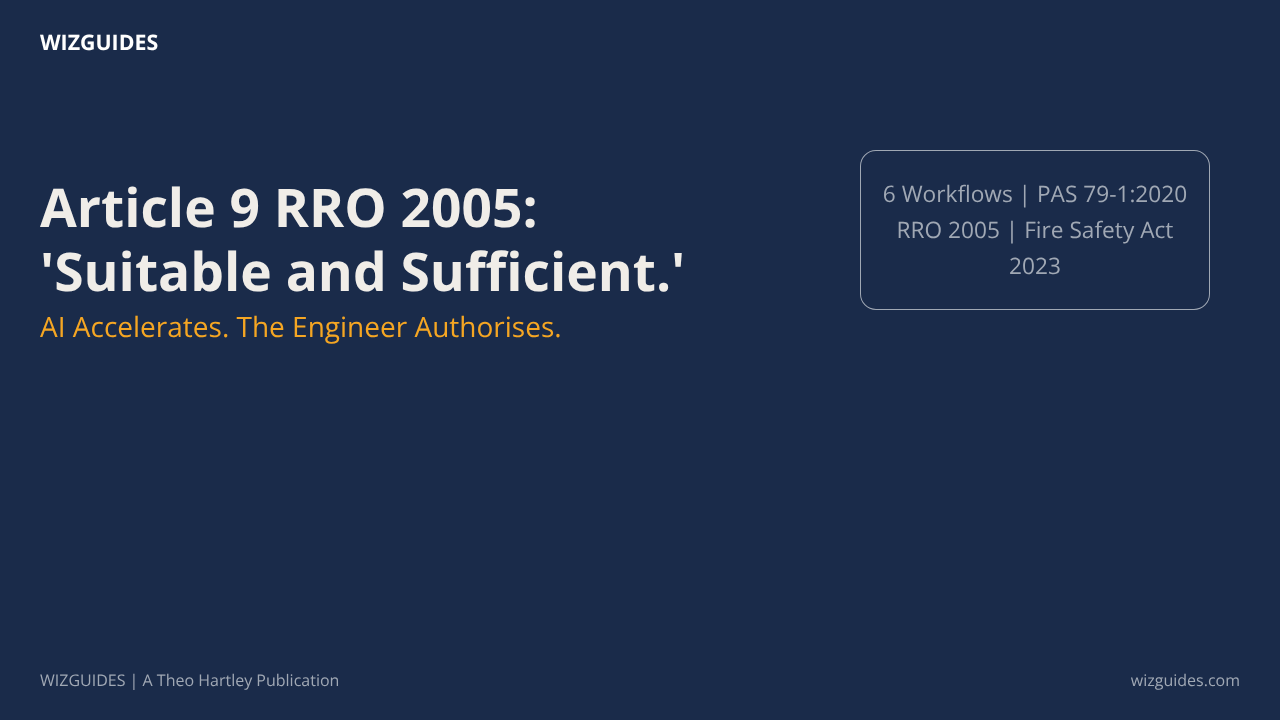
Article 9 and the "Suitable and Sufficient" Standard
Under Article 9 of the Regulatory Reform (Fire Safety) Order 2005, the Fire Risk Assessment must be "suitable and sufficient." It must be conducted by a competent person — someone with sufficient training, knowledge, and experience to identify fire hazards and evaluate risks. It must not be a pro forma document completed at a desk.
That is the legal standard. And it is the right one — because fire kills people, and the FRA is the document that stands between a building's occupants and harm.
The problem is not the standard. The problem is the volume of work required to meet it: 240+ flat entrance doors to inspect on a residential block. Travel distance calculations from floor plans. A comparison against the previous FRA — 18 months old, 12 outstanding actions, no updates since. An action plan to draft and prioritise across 30–100 items. An FRA document to write under the PAS 79-1:2020 five-step methodology.
This work is not intellectually demanding. It is simply time-consuming — and time pressure is where corners get cut.
AI tools can accelerate every step of this process. Not by replacing the Fire Safety Engineer — legally, professionally, and practically, that is not an option — but by handling the repetitive, data-heavy administrative work that consumes your day.
This guide shows you how to use AI tools correctly, consistently, and within the regulatory framework. It is built around the "AI Accelerates; Engineer Authorises" principle: AI assists at every step; the Fire Safety Engineer reviews, edits, and signs the FRA. Every time.
What the Work Actually Looks Like
240 doors. A 15-storey residential block. 120 flats. Each flat has two doors — front door and rear door from the kitchen. Plus communal fire doors on every floor, in the stairwells, in the bin store, in the switch room. 240 individual inspection points, each requiring documentation of intumescent strips, cold smoke seals, self-closer condition, gap measurement, and door leaf integrity.
You could sample 30 doors and note the limitations in the FRA. You know that is not sufficient. But you also have three more properties booked in this week, and the building owner wants the report by Friday.
8 hours of FRA drafting. Survey findings documented. Risk matrix populated. Action plan drafted. PAS 79-1:2020 formatting applied. Cross-referenced. Proofread. The document that represents your professional reputation — and the safety of every person who uses this building.
12–24 months of outstanding actions from the previous FRA. Some marked "in progress" with no update since. Some you cannot even verify without going back on site. The building owner is asking what was fixed. The Fire and Rescue Service is asking for evidence. You have a Word document with a table from 2024.
£525–£875 in Engineer time lost to manual documentation on a single site — time that could be spent on physical inspection, professional judgement, and the work that actually requires a competent person.
This is not a skills gap. This is an administrative bottleneck. And it has a solution.
The AI Acceleration Case
Workflow 1: Fire Door Inspection
Traditional approach: photograph a representative sample. Note limitations. Accept the uncertainty.
AI-assisted approach: photograph every door with a smartphone (overview + detail shots). Use Google Lens or Facio to flag defects from photographs. Get a structured defect report in minutes. Physical verification by the Fire Safety Engineer of every flagged defect. Complete photographic record for the FRA and the building owner.
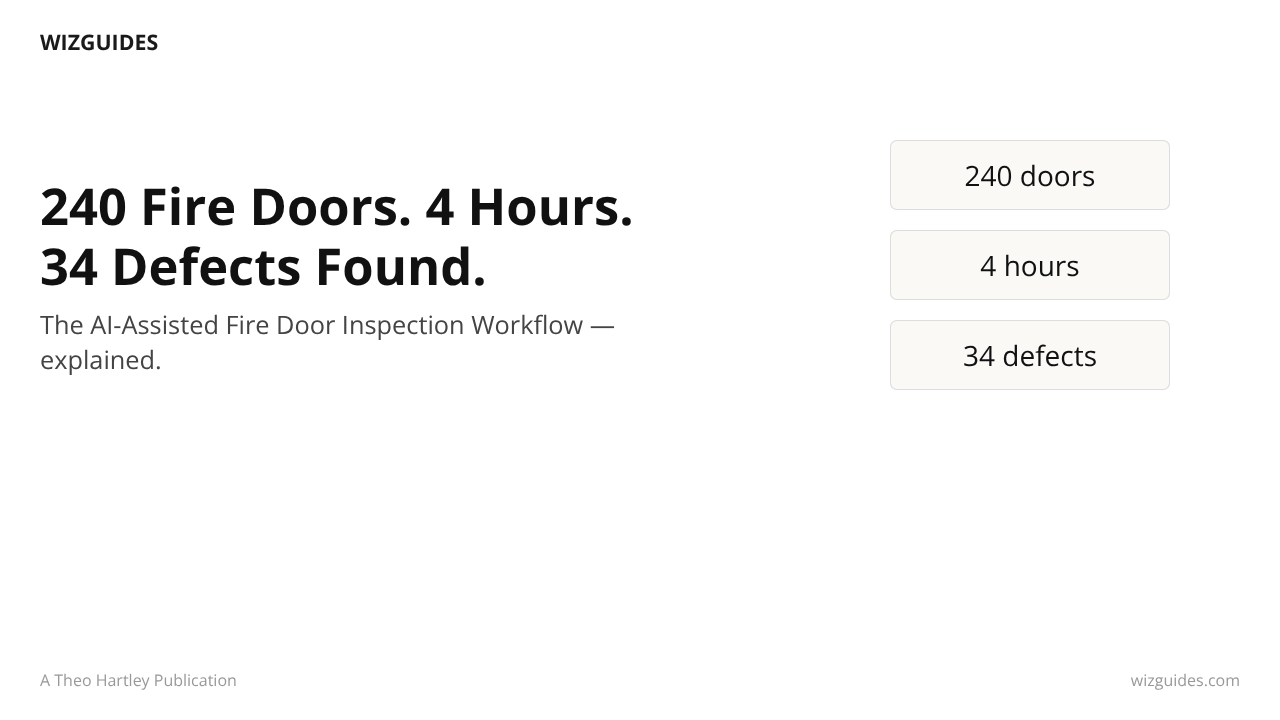
Result: 240 doors inspected in 4 hours. 34 doors with missing intumescent strips identified. Every defect documented. Every finding defensible.
Workflow 2: Delta Report — FRA Comparison
Traditional approach: read both documents side by side. Build a comparison table by hand. Track every action. Identify what changed.
AI-assisted approach: upload both FRAs to Claude 3 or ChatGPT with Advanced Data Analysis. Use the delta report prompt. Get a structured comparison in 8 minutes: 22 actions completed, 12 outstanding, 3 new hazards, risk rating changed from Moderate to Substantial.
Result: an auditable comparison that protects the previous Engineer's work and holds the building owner accountable.
Workflow 3: Spatial Analysis
Traditional approach: print the floor plan. Measure with a ruler. Check against Approved Document B limits. Repeat for every floor and every exit route.
AI-assisted approach: photograph or scan the floor plan. Upload to the AI. Ask for travel distance calculations and exit width analysis against Approved Document B requirements for the relevant occupancy type.
Result: spatial analysis completed in minutes, not hours. Every measurement documented and referenced.
Workflow 4: Risk Matrix and Heat Map
Traditional approach: populate the risk matrix manually, floor by floor, zone by zone. Risk of fire occurring, likely consequences, adequacy of existing controls. Subjective. Inconsistent.
AI-assisted approach: provide structured input (building layout, occupancy type, fire protection measures in place). Get a risk matrix and heat map in minutes, generated from a consistent methodology. Review and adjust based on professional judgement.
Result: consistent, documented risk ratings across the entire building, every floor, every zone.
Workflow 5: FRA Drafting
Traditional approach: 4–6 hours of Word drafting after the survey. Formatting. Cross-referencing. PAS 79-1:2020 requirements checked. Proofreading.
AI-assisted approach: paste structured survey findings into the FRA drafting prompt. Get a complete first-draft FRA document in 12 minutes — structured under PAS 79-1:2020, with risk ratings, action plan, and recommendations. You review, edit, and approve every section. You sign the document.
Workflow 6: Action Plan Prioritisation
Traditional approach: review every action item. Estimate cost and urgency. Prioritise by instinct. Defend your prioritisation in the FRA.
AI-assisted approach: enter all action items into the prioritisation framework. Get a ranked action plan with cost estimates, urgency ratings, and a clear rationale for prioritisation. Justify your decisions to the building owner and the Fire and Rescue Service with a documented methodology.
The Regulatory Constraint — Not a Loophole, a Professional Standard
Article 9 of the RRO 2005 requires the assessment to be made by a competent person. The Fire Safety Act 2023 extended this to include flat entrance doors, compartment walls, and service penetrations in all multi-occupied residential buildings. The Fire Safety (England) Regulations 2022 require Responsible Persons to provide information to residents about fire doors and evacuation procedures.
These are not constraints on using AI. They are the professional standard that makes this guide credible. AI assists. The Fire Safety Engineer signs the FRA. Every time.
The Grenfell Tower Inquiry made clear what happens when the FRA is treated as a pro forma document — signed at a desk, without adequate physical inspection. AI tools supplement physical inspection. They do not replace it. They do not replace you.
Six Workflows, One Methodology
Each workflow is mapped to the PAS 79-1:2020 five-step methodology:
- Identify Fire Hazards — AI-assisted document review and hazard identification
- Identify People at Risk — AI-assisted occupancy analysis and vulnerable person profiling
- Evaluate, Remove, and Reduce Risk — AI-assisted risk matrix and heat maps
- Record, Plan, and Inform — AI-assisted FRA drafting, delta reporting, action planning
- Review — AI-assisted document comparison for periodic review
Tool Stack: Smartphone Camera + Google Lens / Facio | Claude 3 / ChatGPT with Advanced Data Analysis | Adobe Acrobat PDF-to-text | PAS 79-1:2020
Compatible with: RRO 2005 | Fire Safety Act 2023 | Fire Safety (England) Regulations 2022 | Approved Document B | PAS 79-1:2020 | BS 9999:2017 | BS 5839-1:2017 | BS 5266-1:2016 | June 2026
Worked Example: Sarah M., Manchester
Sarah M. is a Fire Safety Engineer working for a housing association in the North West. She has a 15-storey residential block: 120 flats, 240+ doors, one day on site.
Previous approach: sample 30–40 doors, document limitations, spend 6–8 hours on FRA drafting after the survey.
AI-assisted approach: photograph every door with her smartphone. Use Google Lens to flag defects. Physical verification of every flagged defect by Sarah. 240 doors inspected in 4 hours. 34 doors with missing intumescent strips identified and documented. FRA drafted using the AI-assisted framework in 12 minutes.
Result: a more thorough, more defensible FRA — completed in less time. Every door documented. Every defect photographed. Every finding signed under Sarah's professional registration.
Time saved: 4–6 hours. Defects found: 34. Doors inspected: 240.
What's Inside
Guide-Workbook (PDF)
- The "suitable and sufficient" standard and why AI assists, not replaces, the competent person
- PAS 79-1:2020 methodology mapped to six AI workflows
- Fire door inspection: 120-flat residential block worked example (240 doors, 4 hours, 34 defects)
- Delta report: two FRA documents compared in 8 minutes
- Spatial analysis: travel distances and exit widths from floor plans
- Risk matrix: consistent ratings across floors and zones
- FRA drafting: survey notes to document in 12 minutes
- Action plan prioritisation: defensible ranking framework
- Regulatory context: RRO 2005, Fire Safety Act 2023, Fire Safety (England) Regulations 2022, Grenfell context
- Tool stack with version documentation
- Workflow checklists for deployment
Prompt Pack (copy-paste frameworks)
- Tab 1: Fire Door Inspection — systematic AI-assisted assessment protocol
- Tab 2: FRA Comparison — delta report between two FRA documents
- Tab 3: Spatial Analysis — travel distances and exit widths from floor plans
- Tab 4: Risk Matrix and Heat Map — consistent risk rating framework
- Tab 5: FRA Drafting — structured document generation under PAS 79-1:2020
- Tab 6: Action Plan Prioritisation — defensible prioritisation and ranking
Every prompt includes: Context | Task | Format | Worked Examples
Who It's For
This guide is for:
- Fire Safety Engineers with professional registration (IFSM, IFE, or equivalent)
- Responsible Persons under Article 3 RRO 2005 who conduct or commission FRAs
- Professionals conducting FRAs on medium-to-large non-domestic premises — care homes, hotels, offices, schools, mixed-use residential and commercial buildings
- Practitioners who want to reduce administrative burden without compromising the "suitable and sufficient" standard
This guide is NOT for:
- Anyone looking for AI to conduct the FRA without professional involvement
- Non-competent persons seeking to avoid physical inspection
- Practitioners unwilling to review and edit every AI output before signing
Tools
| Tool | Type | Used For |
|------|------|---------|
| Smartphone Camera | Hardware | Fire door, compartment wall, and service penetration photography |
| Google Lens / Facio | AI Image Analysis | Defect flagging from door photographs |
| Claude 3 / ChatGPT | General AI Assistant | Document comparison, spatial analysis, risk matrix, FRA drafting |
| Adobe Acrobat | PDF Processing | Text extraction from FRA documents for AI analysis |
| PAS 79-1:2020 | Methodology | Five-step FRA framework |
| Approved Document B | Regulatory Reference | Travel distances, exit widths |
| BS 9999:2017 | Standard | Fire door gap thresholds (3mm), specifications |
| BS 5839-1:2017 | Standard | Fire detection — Grade and Category |
| BS 5266-1:2016 | Standard | Emergency lighting — category and duration |
Download the Guide-Workbook + Prompt Pack Bundle
Everything you need to implement the workflow on your next project.
Two-part bundle: Combined Guide-Workbook (comprehensive) + Prompt Pack (copy-paste templates)
Includes:
- Full guide-workbook with methodology, worked example, and five exercises
- Complete prompt pack with prompts for every stage of the workflow
- Action plan prioritisation: defensible ranking framework
- Regulatory context: RRO 2005, Fire Safety Act 2023, Fire Safety (England) Regulations 2022, Grenfell context
- Tool stack with version documentation
- Workflow checklists for deployment
---
© 2026 Theo Hartley | WIZGUIDES
⚖️ Practical AI for Professionals ⚖️