
BIM coordination meetings are where the design comes together — and where its flaws become visible.
On a mid-to-large commercial project, a single coordination session can surface between 50 and 200 individual clashes across disciplines: architectural, structural, and MEP. Autodesk Navisworks and BIM 360 identify these conflicts with precision — exact coordinates, element IDs, severity ratings, and 3D viewpoint screenshots. The data is rich. The interpretation challenge is significant.
The Design Manager must translate this raw clash data into a technically accurate, contractually careful, professionally worded Design Coordination Memo. The memo must describe the spatial conflict precisely, present three solution options without recommending any single one, assess preliminary programme and cost implications, and — critically — ask the design team for design direction rather than instructing them to act.
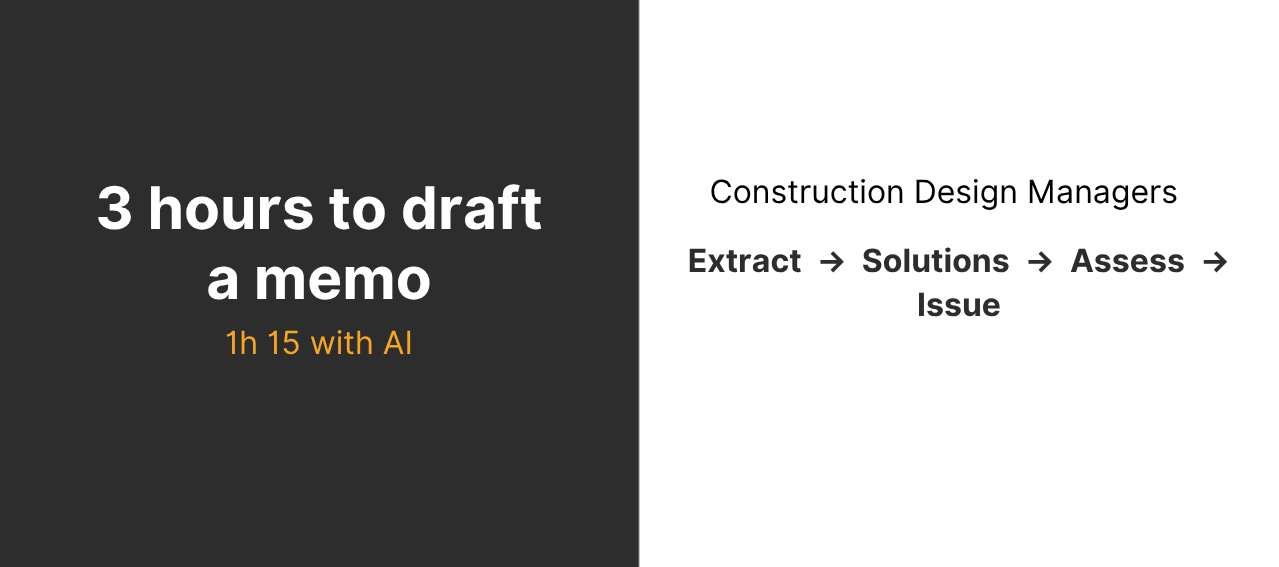
That drafting task takes between 2 and 4 hours per clash.
When 20 critical clashes require formal memos after a single coordination meeting, the drafting burden alone can consume an entire working week. And as the backlog grows — because one meeting always generates more memos than the team can process in the following week — the quality of individual memos tends to decline. Tone errors creep in. Programme implications get missed. The contractual tightrope between asking and instructing becomes harder to walk.
This is the clash memo backlog — and it is one of the most consequential bottlenecks in construction design coordination.
The Three Things Every Clash Memo Must Get Right
A Design Coordination Memo is not just a technical document. It is a professional communication that carries three distinct obligations simultaneously.
- Technical accuracy. The spatial conflict must be described precisely — clash ID, element names, coordinates, discipline pair, and the specific drawing references that are in conflict. An inaccurate description wastes the design team's time and undermines the Design Manager's credibility.
- Contractual neutrality. Under JCT 2016 and NEC4, the constructor does not hold design authority unless expressly granted in the contract particulars. The Architect holds authority over the architectural design. The Structural Engineer holds authority over the structural design. The Design Manager can identify clashes and propose solutions — but they cannot instruct the design team to change anything. Every memo must be a request for design direction, not a directive. An instruction issued without authority is a contractual breach.
- Professional tone. The memo is a formal professional communication that will be retained in the project record. It will be quoted. It may be exhibited in a dispute. The tone must be precise, measured, and professionally appropriate throughout.
These three requirements — technical accuracy, contractual neutrality, professional tone — are not easy to maintain simultaneously when the Design Manager is drafting 20 memos under time pressure. AI assistance with the drafting does not reduce any of these requirements. It reduces the time spent on the mechanics of drafting so that more time is available to get them right.
What the Four-Step Workflow Does
- Step 1 — Clash isolation. The clash is identified, triaged by severity (Critical, High, Medium, Low), and validated. The relevant clash data is extracted from Navisworks Clash Detective and packaged with supporting 2D drawing exports. The package is reviewed for completeness.
- Step 2 — Solution generation. The clash data package is uploaded to **Claude 3** with a structured prompt. The LLM acts as a senior design coordinator and proposes three distinct, standard-industry solutions to the spatial conflict — evaluated across design implication, construction implication, coordination requirement, and preliminary cost implication. All three options are presented without preference or recommendation.
- Step 3 — Impact assessment. For each proposed solution, Claude generates a structured preliminary impact assessment covering schedule, cost, structural and performance risk, constructability, and a formal risk register entry. All figures are flagged as preliminary and subject to QS/PM verification.
- Step 4 — Formal memo drafting. Claude generates the formal Design Coordination Memo using the solution options and impact assessments from Steps 2 and 3. The Design Manager reviews every word, edits for accuracy and tone, adds the contractual disclaimer, and issues under their own sign-off.
The Contractual Tightrope in Practice
The contractual boundary — asking versus instructing — is where the Design Manager's professional expertise does essential work that AI cannot replicate.
A memo that says "The contractor should proceed with Solution 1" has issued an instruction. A memo that says "The design team is requested to confirm the preferred solution" has made a request. The difference is not stylistic — it is contractual.
Claude 3 can generate the three solution options and the preliminary impact assessments. It cannot know the specific contract particulars of this project — whether the constructor holds design authority, whether a Named Specialist subbie has been appointed whose scope is fixed, whether the Architect has confirmed their fee for issuing the revised detail. These are the contextual factors that the Design Manager applies when reviewing the AI-generated draft.
The review step is where the contractual tightrope is walked. The Design Manager who reviews every word carefully — rather than accepting the AI draft at speed because the backlog demands it — is doing the professional work that the workflow is designed to support.
Why the 8-Point Checklist Cannot Be Skipped
The 8-point Design Manager AI Clash Memo Checklist in the guide exists for a specific purpose: to ensure that the review step is completed systematically before every memo is issued.
The checklist items include: confirming clash ID and element names against the source report, verifying that the tone reads as a request not an instruction, confirming that all figures are flagged as preliminary, and confirming that the contractual disclaimer is present.
These are not items that can be reliably checked in a rapid scan. They require deliberate, word-by-word review of each memo before it leaves the office. The Design Manager who uses the checklist consistently will produce better memos — not because AI drafting produces better output, but because having more time for review is what produces better output.
Related Resources
The complete four-step AI-assisted clash memo workflow — including the Navisworks clash data extraction guide, the three-solution Claude 3 prompt structure, the 8-point Design Manager Checklist, and the contractual disclaimer language — is documented in Mitigating Design Ambiguity: Clash Resolution Memos. That guide includes a worked example using a structural beam and M&E duct clash, the tone correction framework, and the formal memo template.
If you are working upstream in the design process and using BIM coordination tools to identify the clashes before they reach the memo stage, The BIM Variance Hunter covers the automated variance tracking workflow that keeps the BIM model aligned with the live cost plan — reducing the clash surface before the coordination meeting begins.
Stop Guessing, Start Systemising
The clash memo backlog is a structural problem created by the gap between the speed at which BIM coordination tools identify conflicts and the speed at which Design Managers can draft formal professional responses. AI closes that gap — not by replacing the Design Manager, but by eliminating the mechanical drafting step so that more time is available for the professional review that no algorithm can perform.
The Clash Resolution Memos workflow has the complete four-step protocol, the Claude 3 prompt structure, the 8-point Design Manager Checklist, and the contractual disclaimer framework. Approximately 1 hour 15 minutes per memo instead of 2–4 hours — with full professional accountability at every step.
Grab it here.
Practical AI for Professionals