

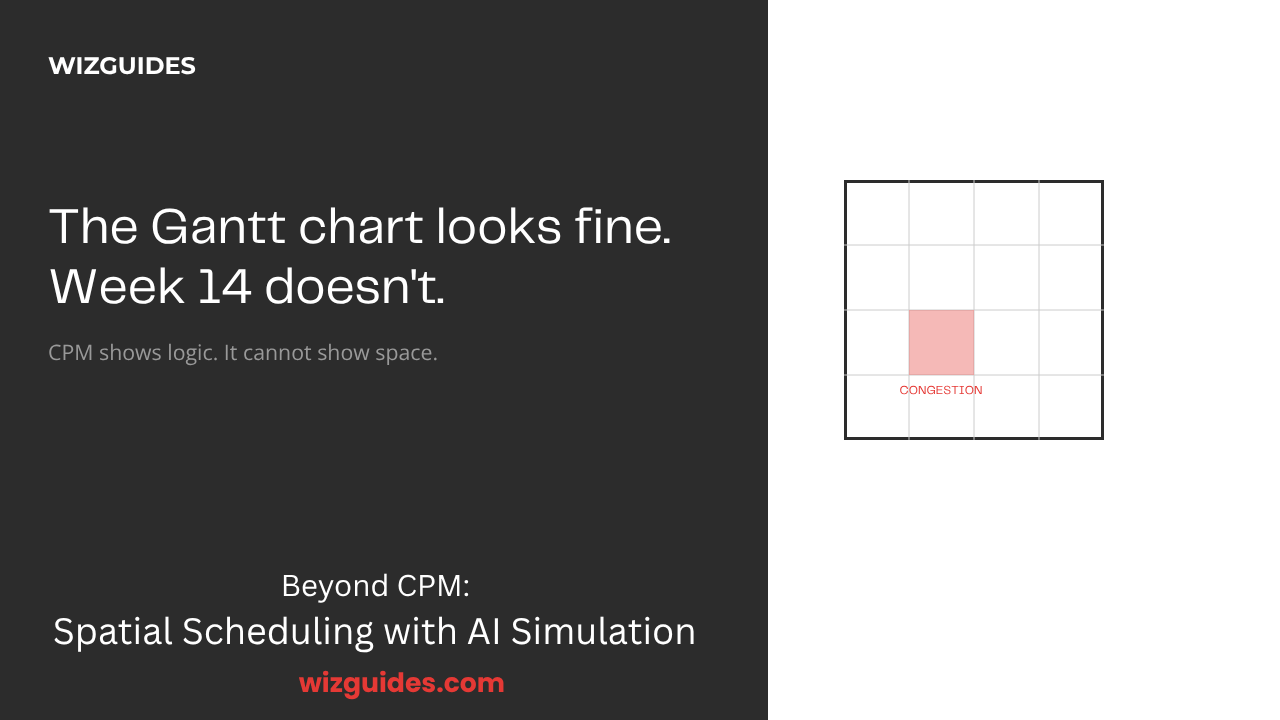
The master programme looks correct. The Gantt chart is clean. Every activity has its predecessors, its logical dependencies, its float calculated to the day. The schedule has been reviewed, approved by the client, and issued to the supply chain.
And then — on the Monday morning of Week 14 — two crews turn up on the same corridor. The same floor. The same tower crane. The project discovers a conflict that was nowhere to be found in P6 or MS Project.
This is the invisible bottleneck problem. It is one of the most persistent and costly failures in construction project management. And it is invisible precisely because the tools most relied upon to prevent it were never designed to detect it.
What CPM Actually Does
CPM — the Critical Path Method — is a time-and-logic model. It answers a single question with extraordinary precision: *What must finish before this activity can start?*
It calculates float. It identifies the critical path. It manages logical dependencies across hundreds of activities. It is indispensable.
The foundational axiom of CPM is that readiness equals startability. If Activity A is complete and Activity B's predecessors are all finished, CPM assumes Activity B can start immediately.
This assumption is silently wrong on almost every complex construction project.
Activity B may need the same corridor as Activity C. Activity B may need the tower crane at the same moment as Activity D. Activity B may need to work in the same zone as Activities C, D, and E simultaneously. CPM shows none of this.
Three Scenarios That Occur Every Week
- The corridor conflict. In Week 14, the CPM schedule shows both the M&E first-fix and the suspended ceiling installation on Floor 3. Both activities have complete logical predecessors. The Gantt chart shows no conflict. In reality, both require the same 2.4-metre access corridor. Only one crew fits at a time. Result: one crew stood down for two days. £14,000 in disruption costs. A delay that did not need to happen.
- The floor overload. A floor that is "on programme" according to CPM may be logistically impossible — 85 operatives scheduled simultaneously in a space designed for 40. No Gantt chart shows this. The PM discovers it when operatives start fighting for floor space.
- The crane conflict. A tower crane is the most constrained resource on many sites. Three trades all need it on Monday morning. CPM has no mechanism to model this. The PM discovers it when the steel erector, the façade contractor, and the mechanical installer are all waiting at the base of the crane at 7am.
The common thread: the PM discovers the conflict when operatives are already mobilised, when the supply chain has already committed, when programme and cost impact is now unavoidable.
Why the Intuition Exists but Cannot Be Validated
Every experienced PM has the nagging feeling that something on the programme is wrong. The sense — built from years of standing on live sites — that Floor 3 will bottleneck in Week 14. The suspicion that two trades will fight for the same access route. The gut feeling that the Gantt chart is not telling the whole story.
That intuition is correct more often than the schedule is.
The problem is that CPM has no mechanism to validate it. The PM who suspects a bottleneck can run additional look-ahead analyses, hold coordination meetings, and ask subcontractors directly — but these are qualitative checks, not quantitative simulations. The schedule says the conflict does not exist. The PM's intuition says it does. Without a simulation tool, the intuition loses the argument.
This is the problem that Alice Technologies was built to solve. Alice applies spatial and labour constraint rules to the CPM programme and simulates what actually happens when operatives arrive on site — identifying where the schedule breaks down physically, before anyone has mobilised.
What Alice Technologies Adds to CPM
Alice Technologies is a generative simulation platform that sits above CPM scheduling tools. Given a coordinated BIM model and a validated P6 or MS Project programme, Alice applies spatial and labour constraints and runs generative simulations to identify where the schedule is physically impossible.
The four-step workflow:
- Step 1 — Model integration. The coordinated BIM model and the validated CPM programme are imported into Alice. The critical linking step — mapping schedule activities to BIM model elements — is completed. This step determines the quality of everything that follows.
- Step 2 — Constraint definition. The PM specifies the physical and operational rules: maximum labour densities per zone, access route restrictions, crane availability windows, zone exclusion periods, crew sizes, client decision milestones, design information release dates. Constraints are classified as hard (must be respected) or soft (preferable but negotiable).
- Step 3 — Generative simulation. The baseline simulation is run against the current CPM schedule. Alice identifies where spatial conflicts occur. What-if scenarios are then generated to test alternative sequences: what if the M&E first-fix moves to the floor below? What if the ceiling installation starts from the east end rather than the west end?
- Step 4 — Strategic realignment. The PM reviews the bottleneck reports with full professional rigour, selects the preferred sequence, presents the recommendation to the project board, and updates the authoritative programme in P6 or MS Project.
Why CPM and Alice Are Complementary
CPM is excellent for managing logical dependencies. It is not designed for spatial or resource constraint simulation. These are different problems, and they require different tools.
The PM who replaces CPM with Alice has made the same mistake as the PM who ignored Alice entirely. The correct use is complementary: P6 or MS Project manages the logical dependencies; Alice tests whether those dependencies are physically feasible in the space available.
This framing is also the correct internal argument for adopting the tool. A senior principal who has spent 20 years building CPM schedules will not accept being told that their tool is inadequate. They will accept — because it is accurate — that CPM handles one problem and Alice handles a different one. The tools are complementary.
The Board Paper That Changes the Conversation
One of the most valuable outputs of the Alice simulation is not the bottleneck report itself — it is the board paper that results from it.
A board paper that states: "Our CPM schedule shows this project is on programme. Our spatial simulation shows a conflict in Week 14 that will cause £14,000 in disruption costs and extend the programme by two days. We recommend the following sequence change to resolve it" — that paper changes the PM's relationship with the board.
Instead of being the person who tells the board the project is slipping, the PM is the person who identified the problem before it happened and presented a solution. That is a different professional conversation.
Related Resources
The complete four-step spatial scheduling simulation workflow — including BIM model requirements (LOD 300 minimum), constraint definition framework, Alice simulation setup, and the board paper template — is documented in Beyond CPM: Spatial Scheduling with Predictive AI. That guide includes the worked example using a commercial core and shell project, the what-if scenario analysis framework, and the programme risk assessment methodology.
If you are working at the earlier stage of the construction process and managing design coordination alongside the programme, The Clash Resolution Memos workflow covers the parallel AI-assisted workflow for drafting Design Coordination Memos from Navisworks clash reports — addressing the design-stage conflicts that Alice identifies before they reach site.
Stop Guessing, Start Systemising
The invisible bottleneck is not a planning failure — it is a tool limitation. CPM was never designed to model spatial constraints. Alice was.
The Beyond CPM has the complete four-step spatial scheduling workflow, the BIM integration guide, the constraint definition framework, and the board paper template. Discovering programme risks before operatives arrive on site — with the evidence to justify the sequence change before the board.
Grab it here.
Practical AI for Professionals